USD/EUR $0.86 +0.01%
Aberdeen Standard Physical Platinum ETF $209.45 -4.99%
USD/CNY $6.98 -0.21%
SPDR Gold Trust $409.23 -0.96%
iShares Silver Trust $70.96 -3.73%
Hedera $0.1199 -2.85%
Stellar Lumens $0.2288 -2.21%
Ripple $2.0933 -3.39%
Bitcoin $90,227.0500 -1.15%
Ethereum $3,119.8037 -1.45%
Inspire Medical Systems (sleep apnea devices) $99.03 +1.87%
Insulet (diabetes/insulin devices) $299.17 +1.64%
Intuitive Surgical $592.27 -0.10%
Qualcomm $180.19 -1.24%
Analog Devices $292.89 -0.02%
Microchip Technology $73.94 -1.24%
Marvell Technology $84.64 -4.07%
ASML Holding (lithography) $1,228.47 -1.10%
Lam Research $203.08 -1.87%
iShares Semiconductor ETF $324.89 -1.05%
MKS Instruments (Semiconductor process equipment) N/A
Specialty Industrial/Materials $22.87 -0.65%
Nevro Corp (neurostimulation devices) $0.00 N/A

USD/EUR $0.86 +0.01%
Aberdeen Standard Physical Platinum ETF $209.45 -4.99%
USD/CNY $6.98 -0.21%
SPDR Gold Trust $409.23 -0.96%
iShares Silver Trust $70.96 -3.73%
Hedera $0.1199 -2.85%
Stellar Lumens $0.2288 -2.21%
Ripple $2.0933 -3.39%
Bitcoin $90,227.0500 -1.15%
Ethereum $3,119.8037 -1.45%
Inspire Medical Systems (sleep apnea devices) $99.03 +1.87%
Insulet (diabetes/insulin devices) $299.17 +1.64%
Intuitive Surgical $592.27 -0.10%
Qualcomm $180.19 -1.24%
Analog Devices $292.89 -0.02%
Microchip Technology $73.94 -1.24%
Marvell Technology $84.64 -4.07%
ASML Holding (lithography) $1,228.47 -1.10%
Lam Research $203.08 -1.87%
iShares Semiconductor ETF $324.89 -1.05%
MKS Instruments (Semiconductor process equipment) N/A
Specialty Industrial/Materials $22.87 -0.65%
Nevro Corp (neurostimulation devices) $0.00 N/A

Visit Market Data
Updated every 15 min
Imec GaN-on-Si MOSHEMT Technology

IIT Madras licenses PIC-based quantum random number generator to industry

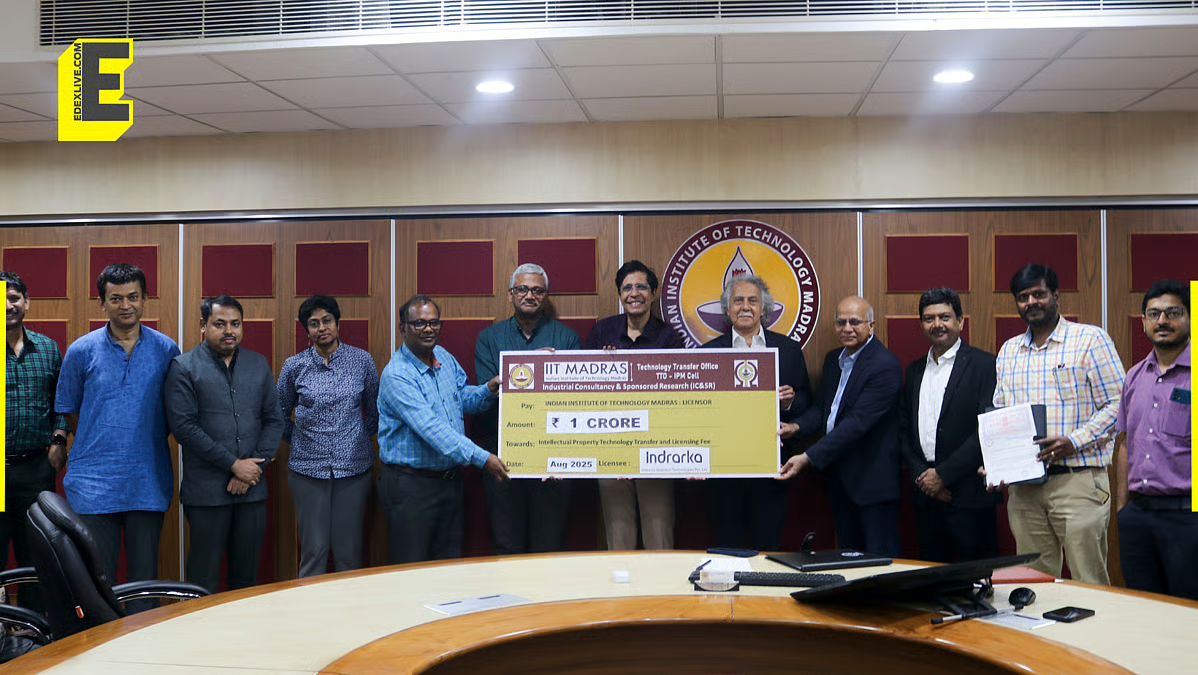
India has taken another decisive step in its quest to become a leader in quantum technology, with the Indian Institute of Technology Madras (IIT Madras) announcing the successful licensing of a silicon photonics-based high-speed quantum random number generator (QRNG) to industry. The technology has been transferred to Indrarka Quantum Technologies, marking the nation’s first commercial deployment of such a device and a landmark moment for India’s quantum innovation ecosystem. The licensing agreement was signed on 18 August by the Technology Transfer Office of IIT Madras, underscoring the institute’s growing role in bridging the gap between advanced research and market-ready solutions. Developed at the institute’s Centre for Programmable Photonic Integrated Circuits and Systems (CPPICS), the QRNG represents one of the most strategically significant applications of silicon photonics in the context of secure computing and communication. Quantum random number generators are critical components for fields where true randomness is essential, from military and defence applications to cryptography, quantum key distribution (QKD), financial transactions, and high-precision scientific simulations. Unlike traditional random number generators that rely on deterministic algorithms and can be vulnerable to prediction or attack, QRNGs harness the intrinsic unpredictability of quantum processes to deliver robust, unhackable randomness. This capability is regarded as foundational for building secure digital infrastructure in the post-quantum era. From prototype to deployment: a Made in India milestone IIT Madras had earlier delivered a prototype version of the QRNG module to DYSL-QT DRDO, a Defence Research and Development Organisation entity focused on quantum technologies. Building on this initial success, an advanced version of the module was later deployed at the Society for Electronic Transactions and Security (SETS Chennai) for quantum security applications. These steps demonstrate not only the viability of the technology but also its readiness for field deployment in mission-critical environments. Kamakoti Veezhinathan, director of IIT Madras, emphasised the importance of this achievement in advancing India’s technological self-reliance. “Silicon photonics is an emerging area with strong interface with quantum technologies. Random number generation is a critical building block for secure computing and communication. I am extremely excited that the CPPICS has developed this QRNG that could be readily deployed in the market,” he said. The licensing to Indrarka Quantum Technologies is thus a natural progression of IIT Madras’s efforts to bring cutting-edge research out of the laboratory and into industry. For India, which has identified quantum technologies as a strategic priority under the National Quantum Mission, this move highlights how indigenous innovation can translate into tangible commercial and security advantages. Industry partnership and the Make in India vision For Indrarka Quantum Technologies, the partnership represents both a commercial opportunity and a chance to contribute to India’s Make in India initiative, which seeks to promote indigenous development of critical technologies. Dinanath Soni, director of the company, called the collaboration a transformative moment. “We are honoured to partner with IIT Madras in bringing India’s first silicon photonics-based QRNG to market. This ground-breaking technology represents a significant leap forward in quantum security solutions and exemplifies the success of the Make in India initiative. We are committed to making this indigenous innovation accessible across critical sectors, establishing India as a global leader in quantum security and advancing our nation’s vision of technological self-reliance.” The government has been quick to acknowledge the milestone as well. S Krishnan, secretary of the Ministry of Electronics and Information Technology (MeitY), congratulated the CoE-CPPICS team during the launch, describing the QRNG module as “a pride for India.” His remarks reflect the central role that government funding and policy support have played in fostering the research environment that made the breakthrough possible. Building India’s quantum future The development of the silicon photonics-based QRNG also speaks to the larger vision of IIT Madras, which has consistently aimed to convert world-class research into market-ready technologies. Manu Santhanam, professor and associate dean for industrial consultancy and sponsored research, said the project embodies the institute’s approach to impactful innovation. “The Centre for Programmable Photonic Integrated Circuits and Systems (CPPICS) embodies IIT Madras’s vision of transforming world-class research into transformative solutions. The successful development and licensing of the silicon photonics-based QRNG is a testament to how focused R&D, backed by strong industry partnerships, can deliver technologies of national importance.” Bijoy Krishna Das, professor and chief investigator of the silicon photonics CoE-CPPICS, highlighted the achievement as a national first. “I believe the field deployable QRNG module is the first silicon photonics-based product from India — a remarkable milestone in our nation’s research journey. I gratefully acknowledge the MeitY, Government of India, for the financial support to establish the silicon photonics CoE-CPPICS at IIT Madras.” He further credited the achievement to a collaborative effort involving faculty members, research scholars, engineers at CoE-CPPICS, and packaging support from izmo Microsystems. The QRNG’s licensing reinforces India’s growing ambition to be at the forefront of the global quantum race. As nations compete to secure leadership in quantum technologies that promise to redefine security, communications, and data infrastructure, India is ensuring that it is not left behind. The field deployment of this silicon photonics-based QRNG is more than a scientific milestone; it is a strategic move that enhances national security, supports indigenous industry, and lays the foundation for India to emerge as a global hub for quantum security solutions. The significance of IIT Madras licensing a silicon photonics-based quantum random number generator extends well beyond the confines of academia or a single industrial partnership. It represents a key inflection point for India’s quantum technology ambitions, bridging years of foundational research with the practical realities of deployment in high-stakes industries. In doing so, the initiative demonstrates how India’s investment in indigenous research capacity is beginning to translate into market-ready products that have both domestic and global implications. Random number generation has long been an underestimated pillar of secure communication and computing. In conventional systems, so-called random numbers are often generated through deterministic algorithms or physical processes that, with enough computational resources, can be predicted or compromised. This has always posed a challenge for security infrastructure, from encryption used in financial transactions to authentication in government and defence systems. Quantum random number generation solves this vulnerability by drawing on the inherent unpredictability of quantum processes, offering a truly random output that cannot be reverse-engineered or tampered with. For India, having this capability developed indigenously means that critical national security systems can be built on infrastructure that is not dependent on foreign vendors or potentially compromised technologies. Globally, the field of quantum random number generation has been led by institutions and companies in Europe, North America, and East Asia, with early commercial deployments already appearing in markets such as Switzerland, Japan, and China. By successfully developing and licensing its own silicon photonics-based QRNG, IIT Madras is ensuring that India not only catches up with these players but does so with a unique technological approach. Silicon photonics provides scalability and compatibility with existing semiconductor fabrication techniques, which means India can potentially achieve large-scale deployment without reinventing its industrial base. This is particularly important for a country that has ambitious plans under its National Quantum Mission, where scalability and cost-effectiveness are paramount. The collaboration with Indrarka Quantum Technologies marks the first time that a product of this kind, conceived and developed within India’s academic ecosystem, is being commercialised for wider market deployment. For Indrarka, the partnership is not just about licensing a piece of technology but about anchoring its business strategy in a space that is poised for explosive growth. As industries from banking and telecommunications to healthcare and aerospace seek quantum-secure infrastructure, companies that can provide field-tested QRNG modules will be well positioned to capture new markets. This alignment between academic innovation and private sector agility is exactly what policymakers envisioned when they called for stronger industry-academia partnerships to drive India’s quantum roadmap. From the government’s perspective, the milestone demonstrates tangible progress on its push for technological self-reliance under the Make in India and Atmanirbhar Bharat initiatives. For years, the country has relied heavily on imported hardware and software for critical security applications. The development of a homegrown QRNG changes that equation, providing confidence that India’s defence, intelligence, and financial sectors can increasingly rely on indigenous technologies. Officials at the Ministry of Electronics and Information Technology (MeitY) have made clear that they see quantum technology as both a national security priority and an economic growth driver, a dual-use framing that mirrors approaches taken by the United States, China, and members of the European Union. The field deployment of the QRNG at organisations such as DRDO’s DYSL-QT and SETS Chennai further illustrates the maturity of the technology. Unlike many early-stage innovations that remain confined to laboratory demonstrations, this QRNG has already proven its reliability in operational environments. This builds credibility not just for the technology itself but for India’s broader quantum ecosystem. When defence laboratories and national security agencies trust a domestically developed quantum module for sensitive applications, it sends a clear signal to both domestic and international stakeholders that Indian research institutions can deliver technologies of global standard. At the same time, the move opens up pathways for cross-border collaborations. As India integrates itself more deeply into global supply chains for emerging technologies, its ability to contribute unique intellectual property—such as silicon photonics-based QRNGs—enhances its role as a valued partner in international research and commercial ventures. While quantum technologies are often subject to restrictions and export controls due to their security implications, trusted collaborations with like-minded countries could allow India to export its innovations in controlled ways, expanding both its economic footprint and its strategic influence. What sets this licensing agreement apart is that it is not a one-off event but part of a broader continuum of efforts at IIT Madras and across India’s higher education system to translate research into commercial impact. The establishment of the Centre for Programmable Photonic Integrated Circuits and Systems (CPPICS) was itself a recognition of the need to concentrate resources and expertise in order to create technologies of national importance. By drawing together faculty members, research scholars, engineers, and industrial partners, CPPICS has created a collaborative ecosystem where complex innovations can move more quickly from theory to application. The involvement of companies like izmo Microsystems, which provided packaging support for the PIC, illustrates the importance of building a network of domestic partners across the technology value chain.